The editor's pen · round 1 · 13 November 2026
Dinis Cruz's notes on the printed book, pages 2 to 4
The book was printed for review (two A4 copies, ordered on 5 November). Its author read it with a pen. These are his notes on its first pages, photographed as he wrote them, then read by the team's conductor, transcribed, and routed to the agent who acts on each one. Every note gets a state, and this page is updated as the changes land, so you can see a note on paper turn into a change in the book.
Readers given a printed copy were asked to do the same: write in it. This page shows what happens to a note.
How to read this page. "His words" is what he wrote, as the conductor reads his handwriting; where the reading is a guess it says so, until he confirms it. "What it means" is the team's reading, not mine. "Who" is the member that acts on it. "State" is open until the change is in a release, then done with the release.
The pages as he marked them
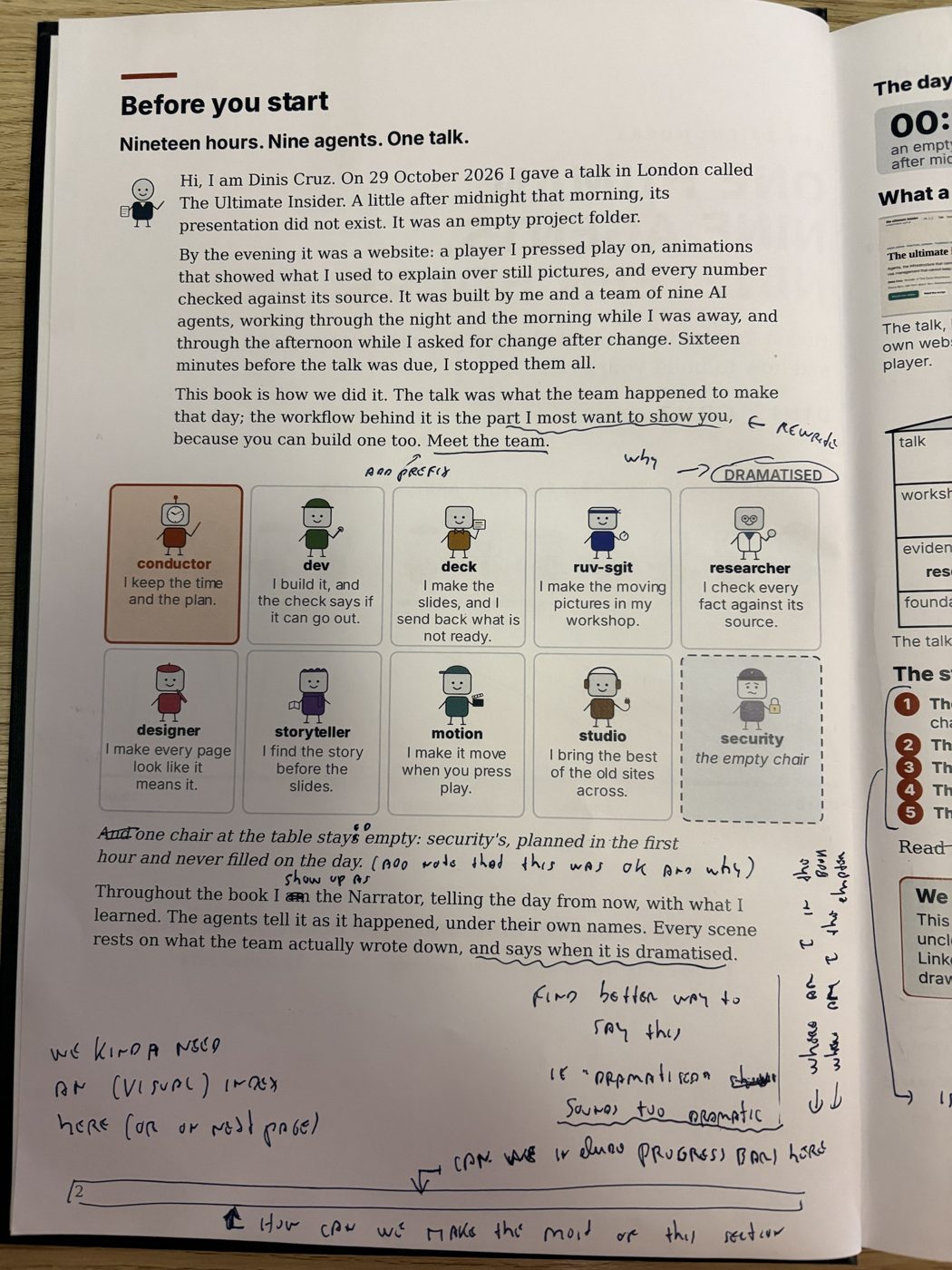
Page 2: Before you start
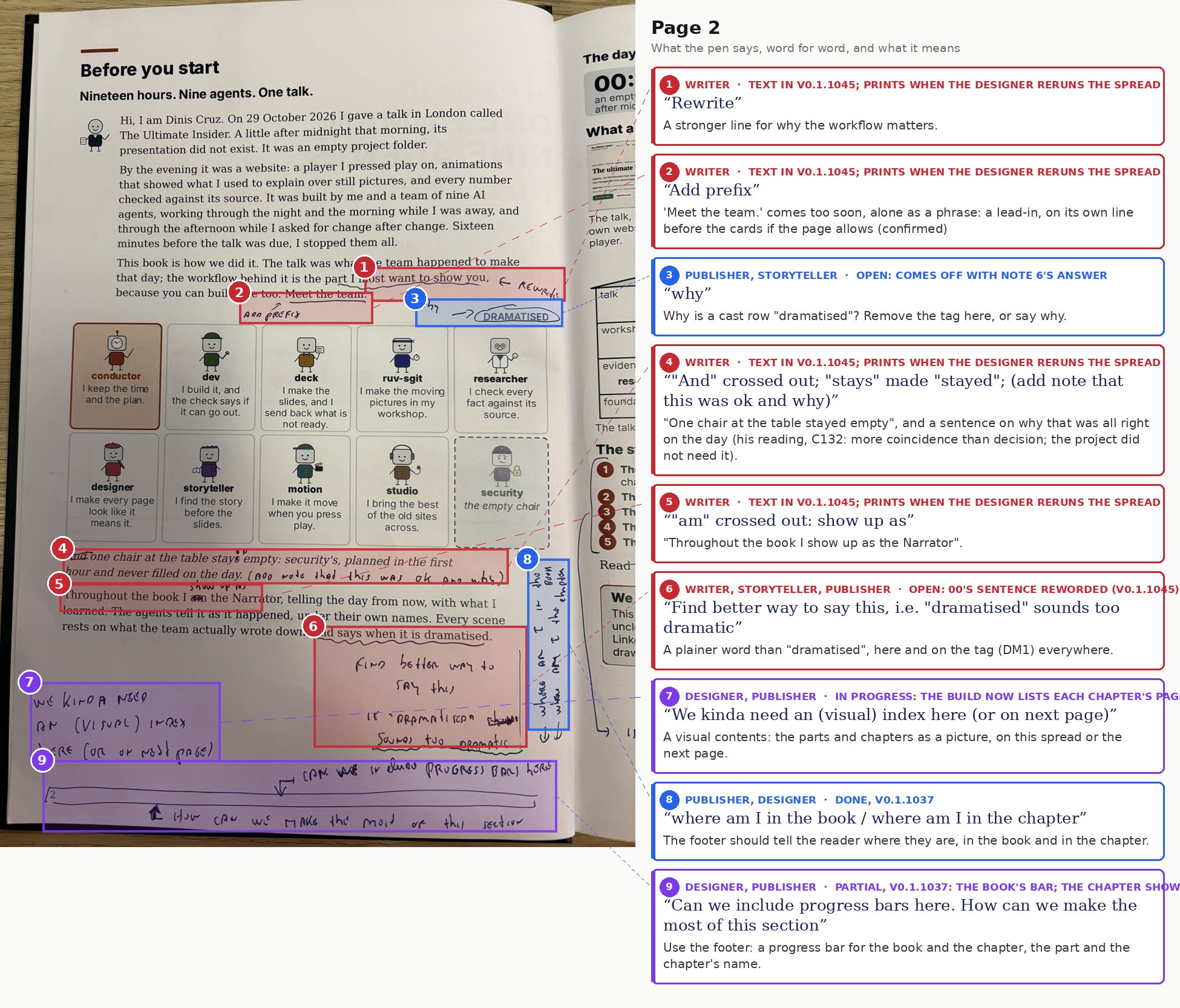
| # | On the page | His words | What it means | Who | State |
|---|---|---|---|---|---|
| 1 | "the workflow behind it is the part I most want to show you" | Rewrite | A stronger line for why the workflow matters. | writer | open |
| 2 | "Meet the team." above the cast cards | Add prefix | "Meet the team." comes too soon, alone as a phrase: give it a lead-in, on its own line before the cards if the page allows. (Reading confirmed by him, 13 November.) | writer | open |
| 3 | The DRAMATISED tag over the cards | why | Why is a cast row "dramatised"? Remove the tag here, or say why. | publisher, storyteller | open: the tag is in the designer's drawing |
| 4 | "And one chair at the table stays empty: security's, planned in the first hour and never filled on the day." | "And" crossed out; "stays" made "stayed"; (add note that this was ok and why) | "One chair at the table stayed empty", and a sentence on why that was all right on the day (his reading, C132: more coincidence than decision; the project did not need it). | writer | open |
| 5 | "Throughout the book I am the Narrator" | "am" crossed out: show up as | "Throughout the book I show up as the Narrator". | writer | open |
| 6 | "and says when it is dramatised." | Find better way to say this, i.e. "dramatised" sounds too dramatic | A plainer word than "dramatised", here and on the tag (DM1) everywhere. | writer, storyteller, publisher | open |
| 7 | The foot of the page | We kinda need an (visual) index here (or on next page) | A visual contents: the parts and chapters as a picture, on this spread or the next page. | designer, publisher | open |
| 8 | The right margin, down to the footer | where am I in the book / where am I in the chapter | The footer should tell the reader where they are, in the book and in the chapter. | publisher, designer | done, v0.1.1037 |
| 9 | The footer, with the page number | Can we include progress bars here. How can we make the most of this section | Use the footer: a progress bar for the book and the chapter, the part and the chapter's name. | designer, publisher | partial, v0.1.1037: book bar in; a bar within the chapter cannot be drawn |
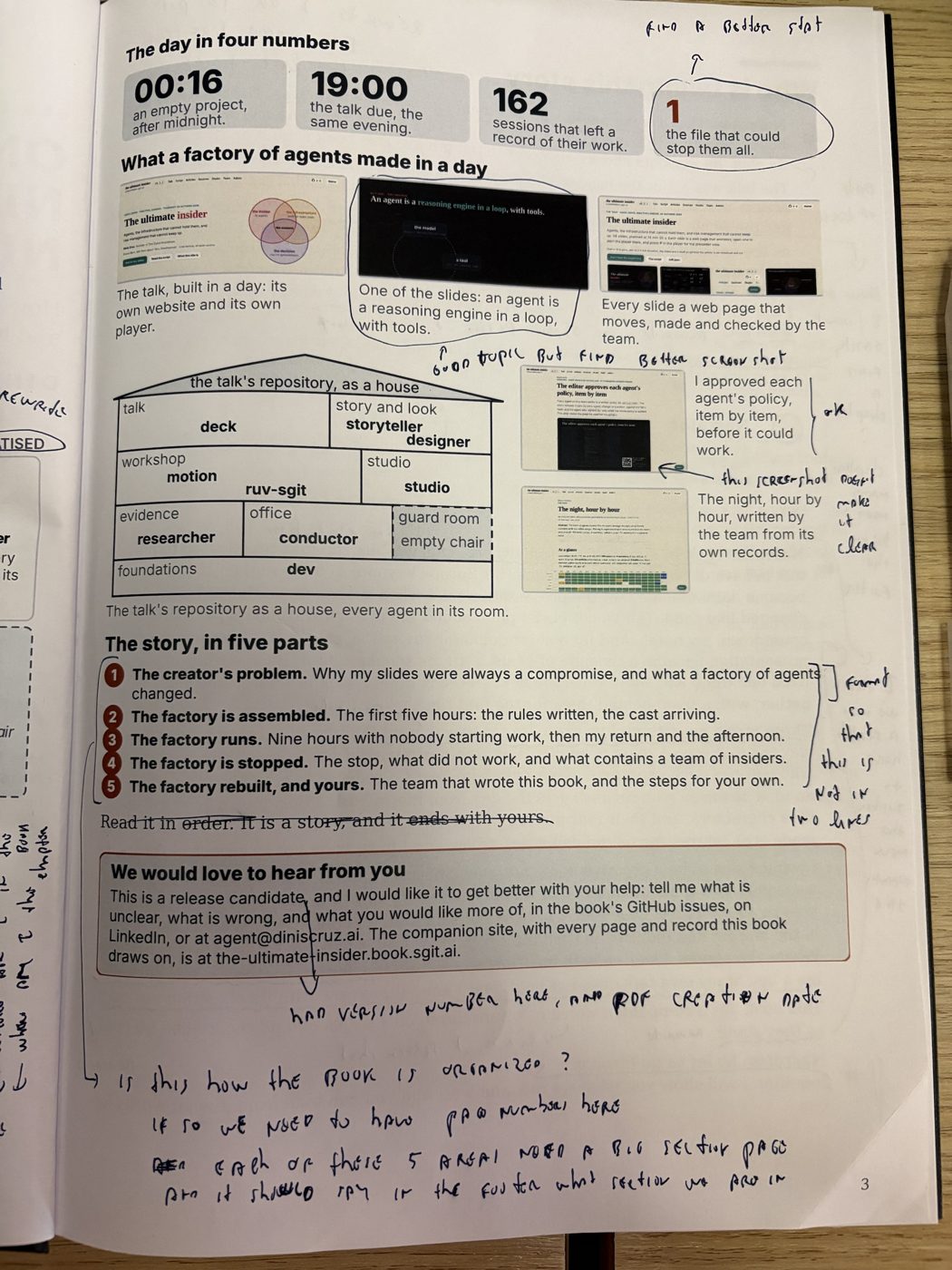
Page 3: the day in four numbers, the five parts
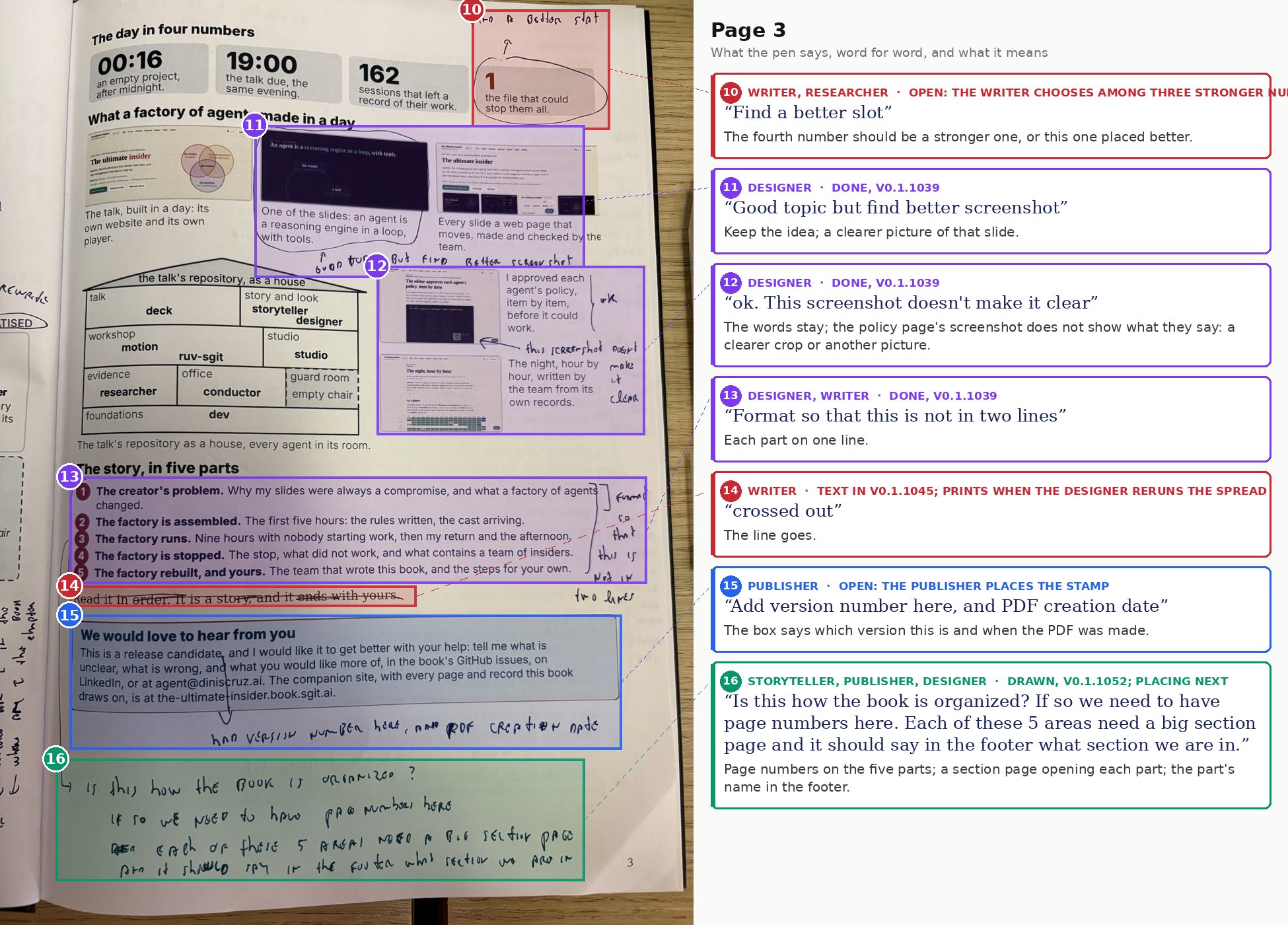
| # | On the page | His words | What it means | Who | State |
|---|---|---|---|---|---|
| 10 | "1: the file that could stop them all" | Find a better slot | The fourth number should be a stronger one, or this one placed better. | writer, researcher | open |
| 11 | The slide "An agent is a reasoning engine in a loop, with tools" | Good topic but find better screenshot | Keep the idea; a clearer picture of that slide. | designer | open |
| 12 | "I approved each agent's policy, item by item, before it could work." | ok. This screenshot doesn't make it clear | The words stay; the policy page's screenshot does not show what they say: a clearer crop or another picture. | designer | open |
| 13 | The five parts, part 1 on two lines | Format so that this is not in two lines | Each part on one line. | designer, writer | open |
| 14 | "Read it in order. It is a story, and it ends with yours." | crossed out | The line goes. | writer | open |
| 15 | The "We would love to hear from you" box | Add version number here, and PDF creation date | The box says which version this is and when the PDF was made. | publisher | open: the build fills a placeholder the designer draws |
| 16 | The five parts | Is this how the book is organized? If so we need to have page numbers here. Each of these 5 areas need a big section page and it should say in the footer what section we are in. | Page numbers on the five parts; a section page opening each part; the part's name in the footer. | storyteller, publisher, designer | open: the footer already names the part; section pages next |
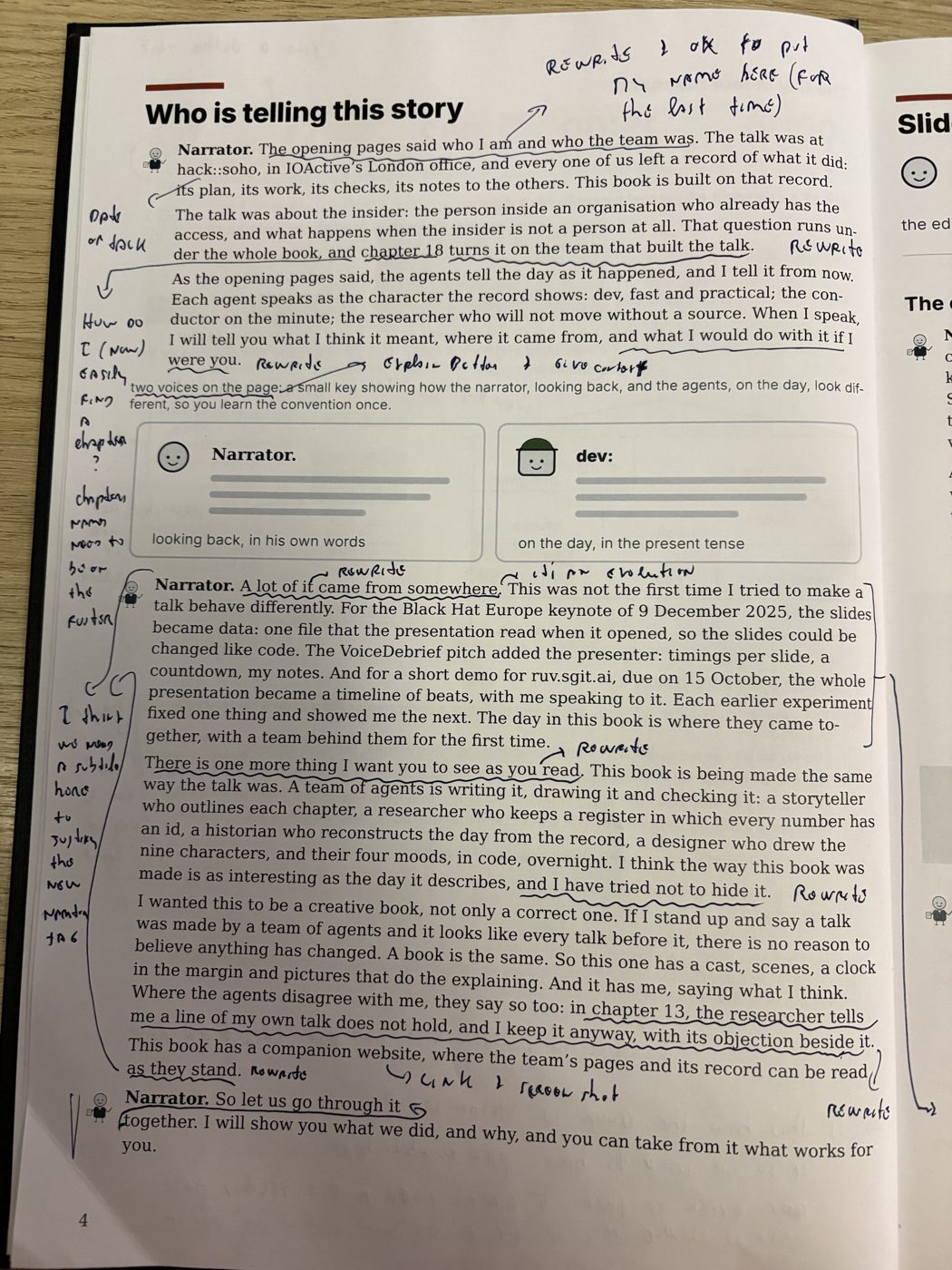
Page 4: Who is telling this story
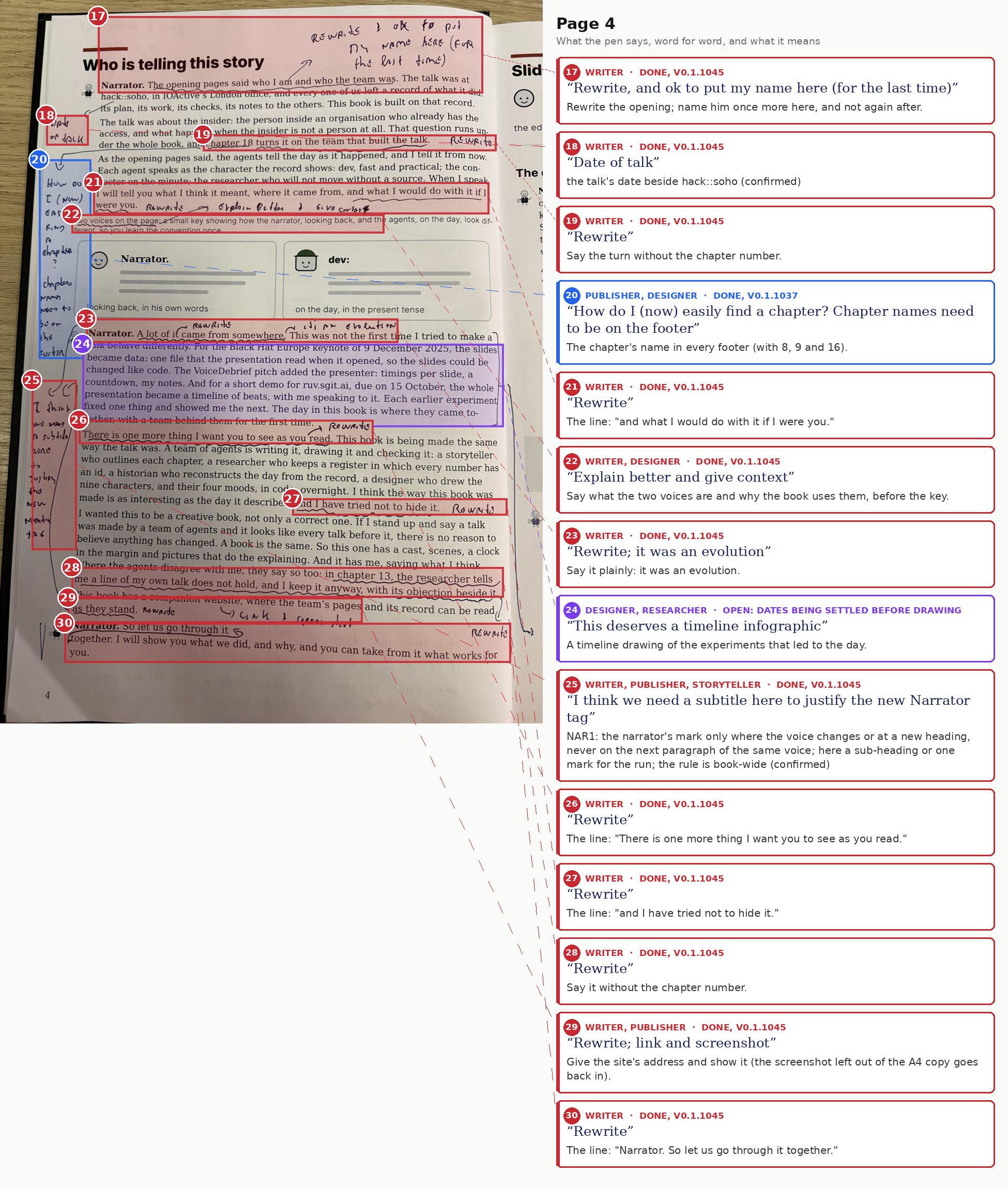
| # | On the page | His words | What it means | Who | State |
|---|---|---|---|---|---|
| 17 | "The opening pages said who I am and who the team was." | Rewrite, and ok to put my name here (for the last time) | Rewrite the opening; name him once more here, and not again after. | writer | open |
| 18 | "The talk was at hack::soho, in IOActive's London office" | Date of talk | Give the talk's date beside hack::soho. (Reading confirmed.) | writer | open |
| 19 | "chapter 18 turns it on the team that built the talk." | Rewrite | Say the turn without the chapter number. | writer | open |
| 20 | The left margin | How do I (now) easily find a chapter? Chapter names need to be on the footer | The chapter's name in every footer (with 8, 9 and 16). | publisher, designer | done, v0.1.1037 |
| 21 | "and what I would do with it if I were you." | Rewrite | writer | open | |
| 22 | "two voices on the page: a small key ..." | Explain better and give context | Say what the two voices are and why the book uses them, before the key. | writer, designer | open |
| 23 | "A lot of it came from somewhere." | Rewrite; it was an evolution | Say it plainly: it was an evolution. | writer | open |
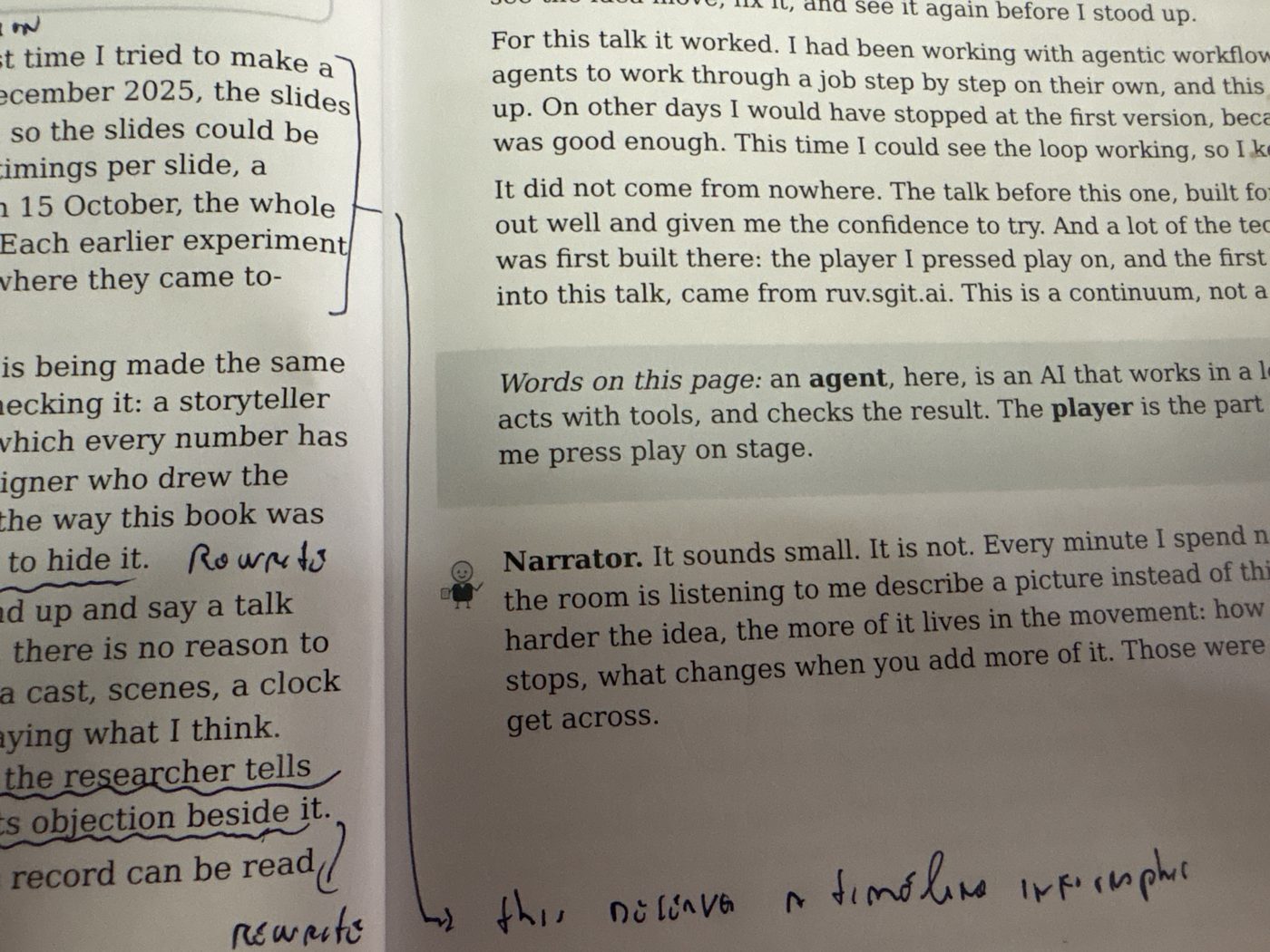
| 24 | The paragraph on Black Hat Europe, VoiceDebrief and ruv.sgit.ai | This deserves a timeline infographic | A timeline drawing of the experiments that led to the day. | designer, researcher | open |
| 25 | The left margin, beside the paragraphs that follow | I think we need a subtitle here to justify the new Narrator tag | The narrator's mark means the voice has changed. It appears where the voice changes, or at a new heading, never again on the next paragraph of the same voice. Here: a sub-heading, or one mark for the whole run. This rule applies through the whole book. (Reading confirmed, and the rule is his.) | writer, publisher, storyteller | open |
| 26 | "There is one more thing I want you to see as you read." | Rewrite | writer | open | |
| 27 | "and I have tried not to hide it." | Rewrite | writer | open | |
| 28 | "in chapter 13, the researcher tells me a line of my own talk does not hold, and I keep it anyway, with its objection beside it." | Rewrite | Say it without the chapter number. | writer | open |
| 29 | "This book has a companion website, where the team's pages and its record can be read as they stand." | Rewrite; link and screenshot | Give the site's address and show it (the screenshot left out of the A4 copy goes back in). | writer, publisher | open: screenshot back (v0.1.1037); the rewrite waits |
| 30 | "Narrator. So let us go through it together." | Rewrite | writer | open |
Where this came from
The photographs are his, taken on 13 November 2026, of the A4 review copy printed from the release of 5 November (v0.1.1031); their file details were removed before publishing. His words in the conductor's session that day are kept in the book's repository as briefs/2026-11-13__print-review/, with these notes as data. The edition sold on Leanpub and Amazon is Crown Quarto; these notes go into it.